Spotting wildlife in Antarctica Antarctica vs Arctic: Which Expedition Is Right for You?

At Wildfoot Travel, three decades of guiding travellers to the world’s great wilderness destinations has taught us that this is usually the first real fork in the road for anyone dreaming of a polar expedition: Antarctica or the Arctic?

They get lumped together constantly, because both are cold, both are white, both involve a small ship and a Zodiac. In reality, they are close to opposites: different hemispheres, different seasons, different wildlife, different governance, and a genuinely different feeling underfoot.

Here is our honest, unfiltered, head-to-head guide to the two poles, starting with the short version, then the detail behind every line of it.

Antarctica vs Arctic: At a Glance

 AntarcticaThe Arctic
What it isA continent surrounded by ocean, owned by no nationA frozen ocean ringed by 8 nations’ territory
SeasonLate October – March
(Southern summer)
May – September
(Northern summer)
Summer temperatures−5°C to +5°C, usually hovering around zero0°C to +10°C
Typical cost, 10–12 days~£6,500–£14,000pp
(from ~£5,000; £20,000+ luxury)
~£5,000–£10,000pp
(from ~£3,500; £15,000+ luxury)
Headline wildlifePenguins, seals, and whales – no land mammalsPolar bears, walrus, muskox, narwhal, and whales
Getting there2 days’ travel; Drake Passage crossing or fly-the-DrakeDirect/short flights to Arctic gateway towns; no ocean crossing
Time at sea1.5–2 days’ open-ocean crossing each way to reach the PeninsulaSheltered fjord and coastal sailing from the moment you embark
People & cultureNone – scientists only, no Indigenous populationInuit, Sami, and Nenets communities and living culture
Landscape signatureTabular icebergs, absolute white, no vegetationTundra, wildflowers, fjords, and drift ice

The Fundamental Difference: A Continent vs. An Ocean

It sounds like a technicality, but it shapes everything else about the trip: Antarctica is a continent surrounded by ocean; the Arctic is an ocean surrounded by continents.

Antarctica

As a single landmass of roughly 14 million square kilometres, bigger than the United States and Mexico combined, governed by no nation. Buried beneath it is an ice sheet averaging over 2 kilometres thick and exceeding 4 kilometres at its deepest, holding around 70% of the world’s fresh water.

The Antarctic Treaty, signed by 12 countries in 1959 and now with more than 50 parties, reserves the continent for peaceful, scientific use.

There is no permanent population, only researchers rotating through more than 70 stations run by around 30 countries, numbers that swell to roughly 4,000–5,000 people in the southern summer and shrink to around 1,000 hardy winterers once the sun sets for the season.

Arctic

The Arctic is not a continent at all, but a frozen ocean ringed by the territory of eight nations, Canada, Greenland (Denmark), Norway, Sweden, Finland, Russia, Iceland, and the United States (Alaska).

Because it’s land-fringed rather than landlocked, it has been continuously inhabited for thousands of years by Indigenous peoples including the Inuit, Sami, and Nenets, and much of the ground beneath your feet on an Arctic hike is permafrost, soil that has stayed frozen for at least two consecutive years, in places for millennia.

Wildlife: Penguins vs Polar Bears

This is usually the deciding factor for our clients, and it’s a genuine either/or — the two poles do not share their headline species.

Antarctica

In Antarctica, the stage belongs to penguins: chinstrap, gentoo, Adélie, king, macaroni, and the elusive emperor. Leopard, crabeater, Weddell, fur, and elephant seals haul out on the ice alongside them.

For king penguins, South Georgia is unmatched: Saint Andrews Bay holds the largest king penguin colony in the world, with estimates ranging from around 150,000 breeding pairs upward — one of the great wildlife spectacles anywhere on the planet.
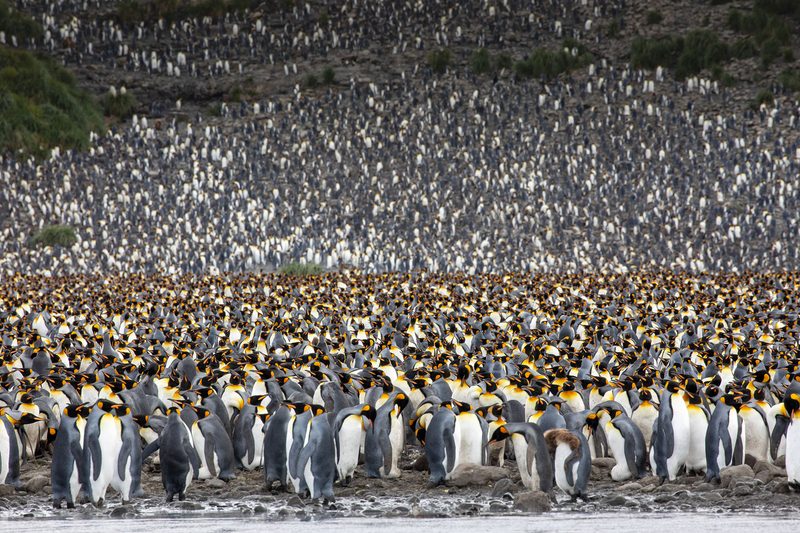
Penguins are a highlight of Antarctica

There are no native land mammals of any kind. Whales are a genuine highlight rather than a footnote — humpback, minke, orca, and fin whales are all commonly encountered, with February and March the peak of the season.

Arctic

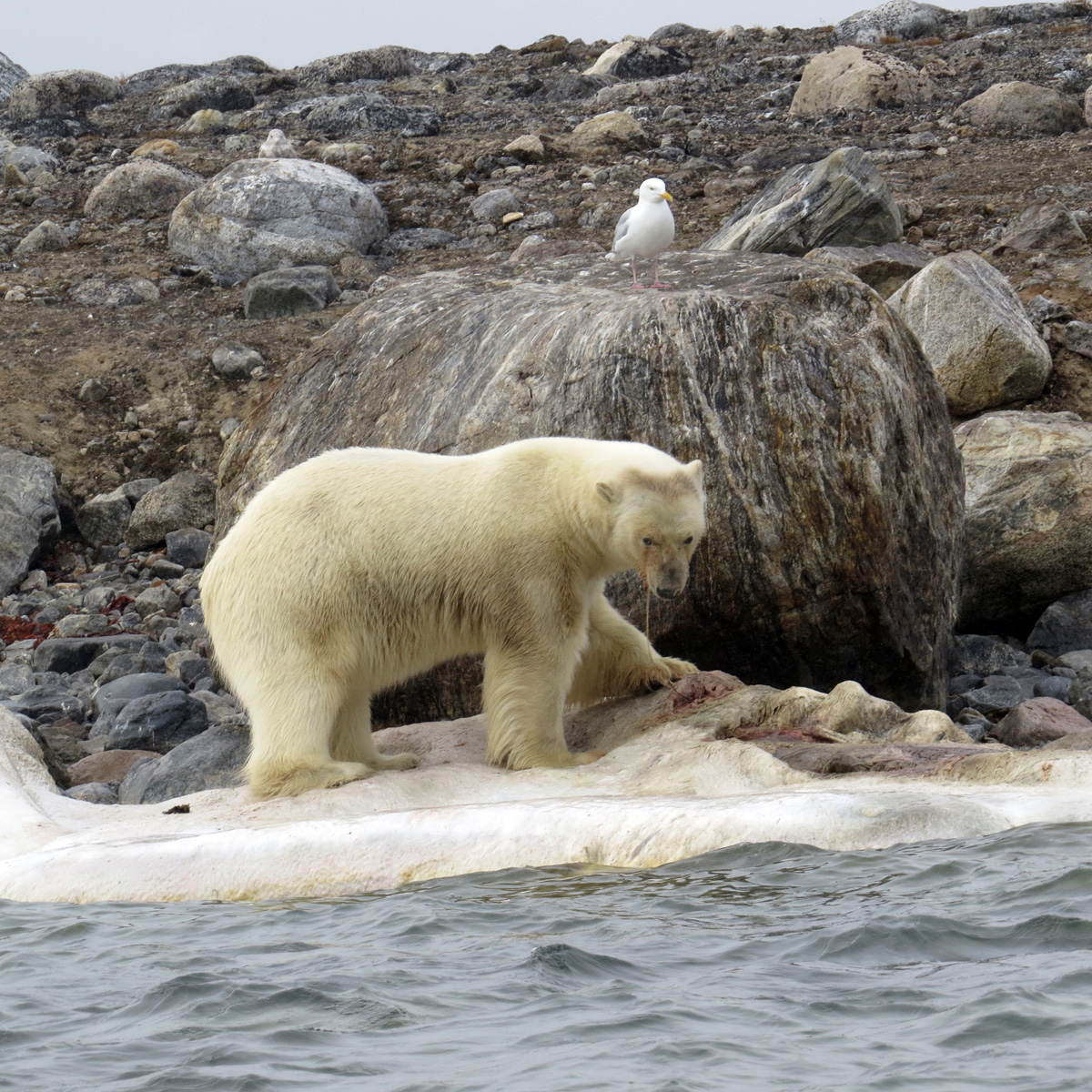
The polar bear is the animal most people come to The Arctic for — the region’s apex predator and the largest carnivore on land. Around it sits something Antarctica simply doesn’t have: true land mammals, including muskox, reindeer and caribou, and Arctic fox.

In the north, Svalbard offers the best opportunity in the European Arctic to see a bear in its true habitat, out on the sea ice — though sightings are never guaranteed there. For near-certain sightings, Churchill in Manitoba remains the more dependable choice, with bears gathering on shore each autumn.

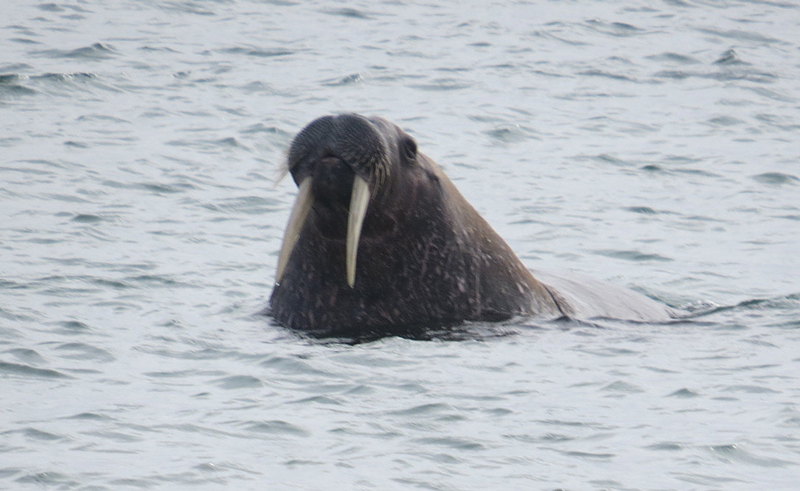
Offshore and along the ice edge, walrus — marine mammals, despite the hauled-out beaches they’re famous for — gather in their hundreds. The whale list is longer and more varied too, with humpback, beluga, bowhead, fin, minke, and orca all commonly spotted.

See Polar Bears in the wild in the Arctic

Where you sail matters as much as when. The Antarctic Peninsula and South Shetland Islands are the reliable stage for Adélie, chinstrap, and gentoo penguins, while the emperor penguin, the largest and most elusive of the Antarctic penguins, breeds almost entirely on fast ice in the Weddell and Ross Seas, with Snow Hill Island the most consistently visited colony, usually reached only on specialist helicopter- or icebreaker-assisted voyages.

Walrus haul-outs are a spectacle in their own right, around Svalbard and Greenland, hundreds of Atlantic walrus can crowd a single beach, while narwhal and beluga follow the retreating sea ice edge in the high Canadian Arctic and along Greenland’s coast.

For me, Greenland is all about scale. There’s something about the icebergs there — in my mind, they felt even larger than Antarctica’s. Set against the colourful tundra and red rock of Røde Ø in ScorPeople often ask me what’s been the highlight, out of all the incredible places I’ve been lucky enough to experience. There are strong contenders.

The first time I saw a polar bear and her cubs, on our very last landing in Scoresbysund, East Greenland, is right up there. So is paddling out in Svalbard towards what looked like two black rocks in the ocean, only to realise they were humpback whales sleeping – “logging,” as it’s known – and we were so close we could feel the mist from their blowholes. – James Turner, Wildfoot Travel

But if a specific animal is the reason you’re going, the choice largely makes itself: penguins mean Antarctica, polar bears mean the Arctic.

Season and Timing: Two Opposite Summers

Because the poles sit in opposite hemispheres, their travel seasons are mirror images of each other.

Antarctica

Runs late October to March

October and November bring pristine snow, dramatic sea ice, and penguin courtship displays.

December and January offer the mildest weather, the most active wildlife, and penguin chicks on the Peninsula,at peak pricing.

February and March are the height of whale season.

Arctic

Runs May to September

May and June open the Svalbard season as birdlife returns.

June to August is the peak, under 24-hour midnight sun

August and September bring the Northwest Passage’s brief navigable window, and the first Northern Lights of the season as the sun begins to set again.

Wildfoot recommendation: if your calendar only allows for a European or North American summer holiday, the Arctic is the natural fit. If you’re free in the northern winter, Antarctica is where the season is actually open.

Getting There: Accessibility and the Journey Itself

Antarctica

Most expeditions depart from Ushuaia, Argentina (via Buenos Aires) or Punta Arenas, Chile. Traditional itineraries cross the 800km Drake Passage — typically a 1.5 to 2-day sea crossing each way — while ‘fly-the-Drake’ charter flights to King George Island skip it entirely.

Whichever route you choose, reaching the ship takes around two full days of travel from the northern hemisphere.

Arctic

Considerably closer for European and North American travellers. Gateway towns like Longyearbyen (Svalbard), Tromsø, Reykjavik, and Kangerlussuaq are reachable on direct or short connecting flights, often four to nine hours from London or New York.
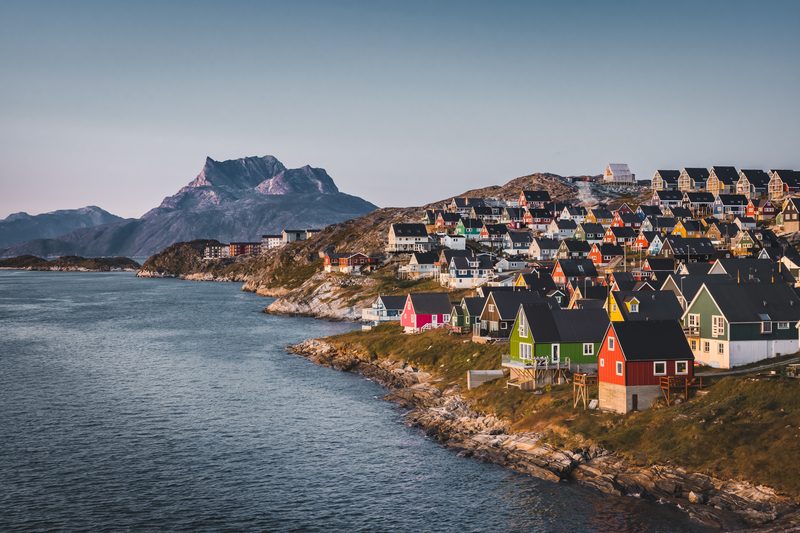
Nuuk, the capital and largest city of Greenland.

There is no equivalent open-ocean crossing — embarkation is usually straightforward, and you are into sheltered fjord and coastal sailing almost immediately.

Our Antarctica route options page breaks down itinerary lengths and starting points, and our Antarctica vessels guide covers the ships.

On the other pole, see our Arctic route options for how Svalbard, Greenland, and the Northwest Passage connect into a single itinerary.

What It Costs

Both poles cover a wide range — the ship, cabin category, itinerary length, and season all move the number by thousands of pounds.

As a rule of thumb, the Arctic has the lower entry point, largely because it’s quicker to reach and doesn’t require the Drake Passage’s extra sailing days.

Per personAntarctica
10–12 days
Arctic (Svalbard)
8–12 days
Entry levelFrom ~£5,000–£6,500From ~£3,500–£5,000
Mid-range~£6,500–£14,000~£5,000–£10,000
Luxury£20,000–£40,000+£12,000–£20,000+

Figures are indicative per-person, twin-share fare ranges for 2026/27 season sailings, excluding international flights and gratuities unless stated. Prices vary by operator, ship, and date — get in touch for a quote against your specific dates.

People and Culture

If a sense of human history and living culture matters to your trip, this is a real point of difference.

Antarctica

Antarctica has never had permanent residents. There is no Indigenous population and never has been. Its human story is one of exploration rather than habitation — Shackleton, Amundsen, Scott — and the only people there today are rotating scientists at research stations.

Arctic

The Arctic has been lived in for thousands of years. Inuit, Sami, and Greenlandic communities have made their home here across generations, and voyages routinely include community visits, museums, and cultural performances. It is a living culture, not simply a historical one.

Cold, Scale, and Landscape

Both regions get described in extremes, but the reality of a summer expedition is far more comfortable than the headline statistics suggest. Around the Antarctic Peninsula in season, temperatures tend to hover between −5°C and +5°C — usually close to zero. Arctic summer temperatures typically run from 0°C to as much as +10°C. You will want good layers, not survival gear.

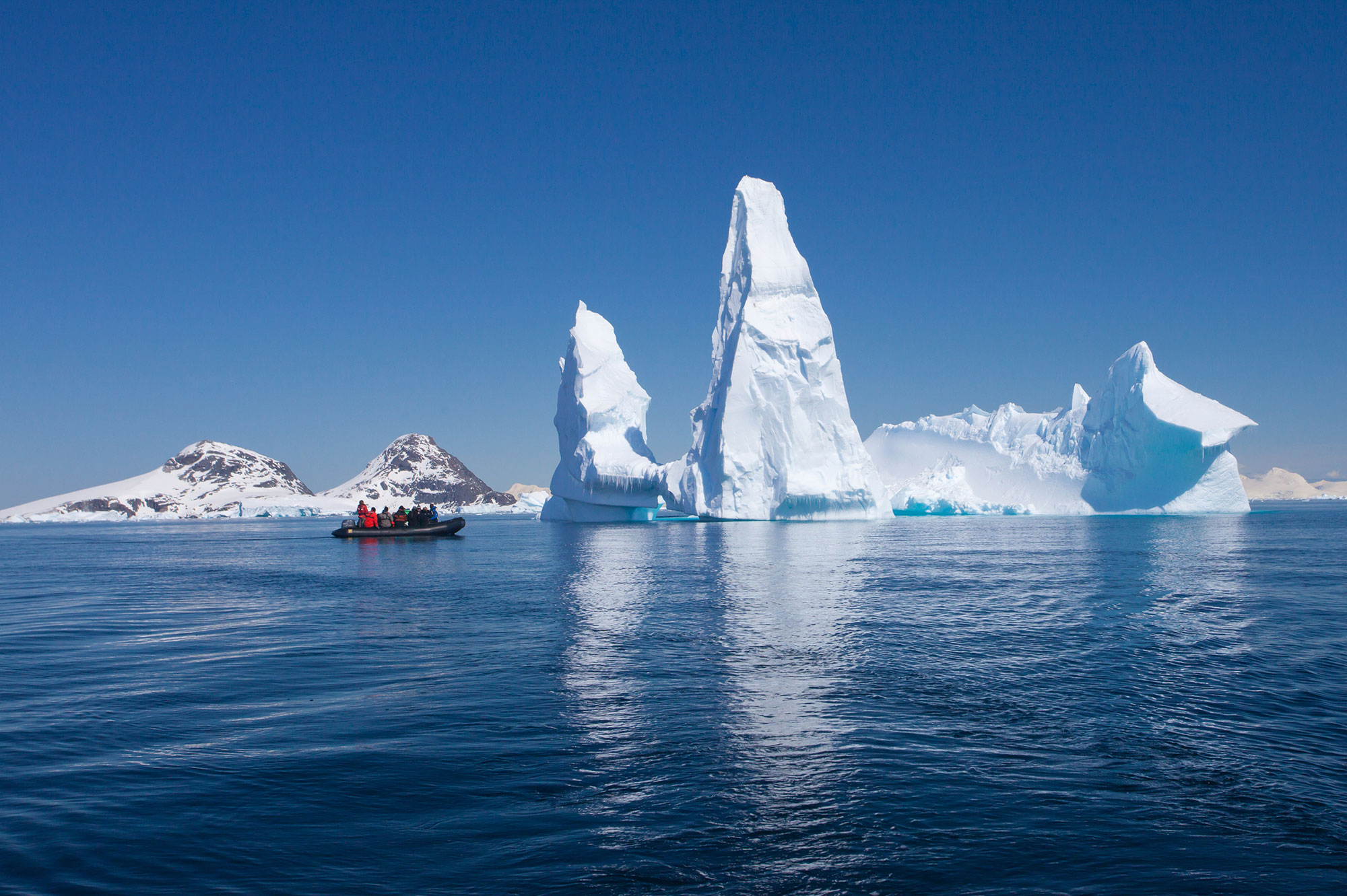
Where Antarctica genuinely does win on scale is its ice. Tabular icebergs — flat-topped, sometimes the size of small countries — are unlike anything the Arctic produces, and the continent is entirely blanketed by an ice sheet, with no vegetation to soften it.
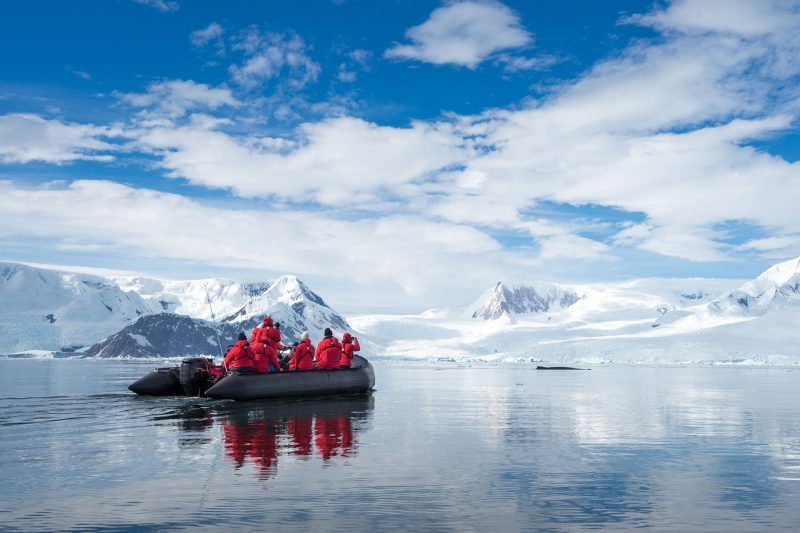
Stunning landscapes in Antarctica
The stunning landscapes of Antarctica

The Arctic, by contrast, is greener in summer. Tundra, wildflowers, and moss appear as the snow retreats, and its fjords, drift ice, and calving glaciers offer a softer, more varied landscape. Arctic sea ice is thinner and far more seasonal, shrinking to a fraction of its winter extent by September — which is precisely why the Arctic cruising season is so tightly bound to those summer months.

Both share dramatic tidewater glaciers and near-24-hour summer daylight. But where Antarctica feels otherworldly and absolute, the Arctic feels wild but inhabited.

Which Pole Suits You

Beyond the headline facts, here’s how we tend to advise different types of traveller.

First-time polar travellers

For UK clients especially, we often suggest starting in the Arctic. A classic Svalbard voyage is easily reached, unmistakably polar from the moment you land, and a superb way to dip a toe into expedition travel — and it sets you up beautifully for Antarctica later.

That said, if you only ever take one polar trip, Antarctica with the Falklands and South Georgia is the one that will live far beyond any expectation, for the sheer concentration of wildlife and dramatic ice alone.

If I had to pick just one moment above all of them, it would be the first time I landed at Gold Harbour, South Georgia. A stunning panorama of jagged mountains under blue skies, a beautiful sandy beach framed by lush green tussock grass – and then, carpeting every inch of it, tens of thousands of king penguins and hundreds of elephant seals as far as the eye could see. It’s the only time in my life I’ve physically frozen in awe at the sheer magnificence of nature. My brain simply couldn’t compute the spectacle in front of me. It took several minutes before I realised I didn’t need to stand rooted to the spot – I could actually walk along the beach and find my own place to take it all in. It remains the most magical moment of my life, and I still get goosebumps thinking about it – James Turner, Wildfoot Travel

Families with older children

The Arctic’s shorter flights, gentler seas, and cultural stops tend to suit families better, especially with children under 12, who most Antarctic operators don’t accept aboard. Always check age policies directly, as they vary by ship.

Photographers

Both are exceptional, but for sheer scale and light, Antarctica’s icebergs and 24-hour December daylight are hard to beat. For a single, dramatic subject, the Arctic’s polar bears on sea ice are the more coveted shot — at the cost of a much lower hit rate.

Solo travellers

Both regions are well set up for solo travellers, with most expedition ships offering solo cabins or roommate matching. The Arctic’s shorter itineraries and lower entry point make it the easier region to try first if budget is the main consideration.

Anyone prone to seasickness

This one has a clear answer: the Arctic. Most Arctic itineraries sail sheltered coastal and fjord waters, while an Antarctic trip almost always means the Drake Passage — two open-ocean crossings, unless you choose (and pay more for) a fly-the-Drake itinerary.

The Master Checklist: Matching the Pole to Your Ambitions

Before you commit to a hemisphere, run your choice through these five filters:

Name your must-see animal

If it’s penguins, only Antarctica will do. If it’s a polar bear, only the Arctic offers a chance, and even there, a sighting is never guaranteed.

Check your calendar

Antarctica’s season runs late October to March; the Arctic’s runs May to September. Your available travel dates may decide this for you before anything else does.

Be honest about time and budget

Antarctica asks for a longer journey, more days at sea, and a higher entry point. The Arctic is quicker and more accessible to reach from Europe and North America.

Consider your sea legs

The Drake Passage is a genuine one-and-a-half to two-day ocean crossing each way, while most Arctic itineraries sail in comparatively sheltered coastal and fjord waters.

Decide what else you want from the trip

If Indigenous culture and a lived-in landscape matter to you, the Arctic delivers something Antarctica structurally cannot. If you want scale, silence, and the sense of standing on an untouched continent, that belongs to Antarctica alone.

That said, if you only ever take one polar trip, Antarctica with the Falklands and South Georgia is the one that will live far beyond any expectation, for the sheer concentration of wildlife and dramatic ice alone.

Really, every day out in the Arctic or Antarctica is special in its own way – the excitement of not knowing what the day holds, the sense that Mother Nature is unveiling a script unique to that exact moment, the unexpected encounters with local Inuit communities that always leave a warm place in my heartesby Sund, the contrast is magnetic for photographers; the ice seems to pop right off the landscape – James Turner, Wildfoot Travel

Frequently Asked Questions

Is Antarctica or the Arctic colder?

Antarctica, though not in a way most travellers experience. Expedition season around the Peninsula sees temperatures hovering between −5°C and +5°C, usually close to zero, while Arctic summers run from 0°C to around +10°C. Both are comfortable with good layers.

How do the costs compare?

The Arctic generally has the lower entry point. A typical 8–12 day Svalbard voyage starts below an equivalent Antarctic Peninsula sailing, largely because it’s quicker to reach and doesn’t require the extra sea days of the Drake Passage. Both regions offer everything from simple expedition ships to genuine six-star vessels.

Can you see penguins and polar bears on the same trip?

No — not in the wild. Penguins are exclusively Southern Hemisphere and polar bears are exclusively Arctic; their ranges never overlap. Seeing both means booking two separate expeditions, one to each pole.
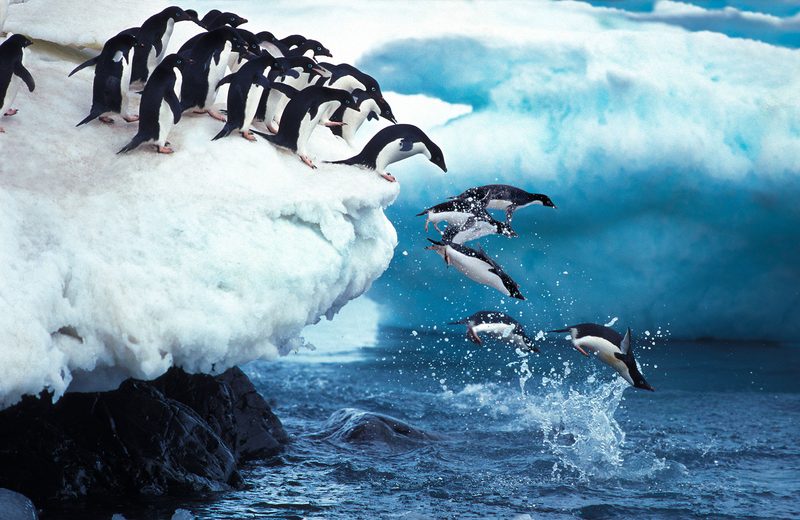
Unforgettable wildlife encounters in Antarctica

Which is easier to get to?

The Arctic. Gateway towns like Longyearbyen, Tromsø, and Reykjavik are a direct or single-connection flight from most of Europe and North America. Antarctica requires flying to Ushuaia or Punta Arenas at the southern tip of South America, plus a Drake Passage crossing or charter flight to reach the ship itself.

Is the sea crossing to Antarctica rough?

It can be. The Drake Passage has a reputation for a reason, though modern stabilised ships and X-BOW® hull designs have made the crossing considerably more comfortable than it once was. ‘Fly-the-Drake’ itineraries avoid it entirely for an added cost.

Which is better for a first-time polar traveller?

If you’re planning to visit both poles eventually — and we’d highly recommend it — start with the Arctic. Svalbard is the quintessential Arctic experience, easily accessible from the UK, and sets you up beautifully for an Antarctic expedition in future.

If you’ll only ever make one trip, Antarctica with the Falklands and South Georgia just about wins it.

Talk to Us

There is no wrong answer between Antarctica and the Arctic — only the trip that matches what you actually want to see, when you’re free to travel, and how you want to feel when you get there.

We have sailed both. We know the ships, the seasons, and the small details — which crossing suits a nervous sailor, which month gives you cubs or chicks, which itinerary is worth the extra cost — that make the difference between a good trip and the trip of a lifetime.

Get in touch with the Wildfoot Travel team to help you choose your polar adventure, or start browsing our Antarctica cruises and Arctic cruises for yourself.
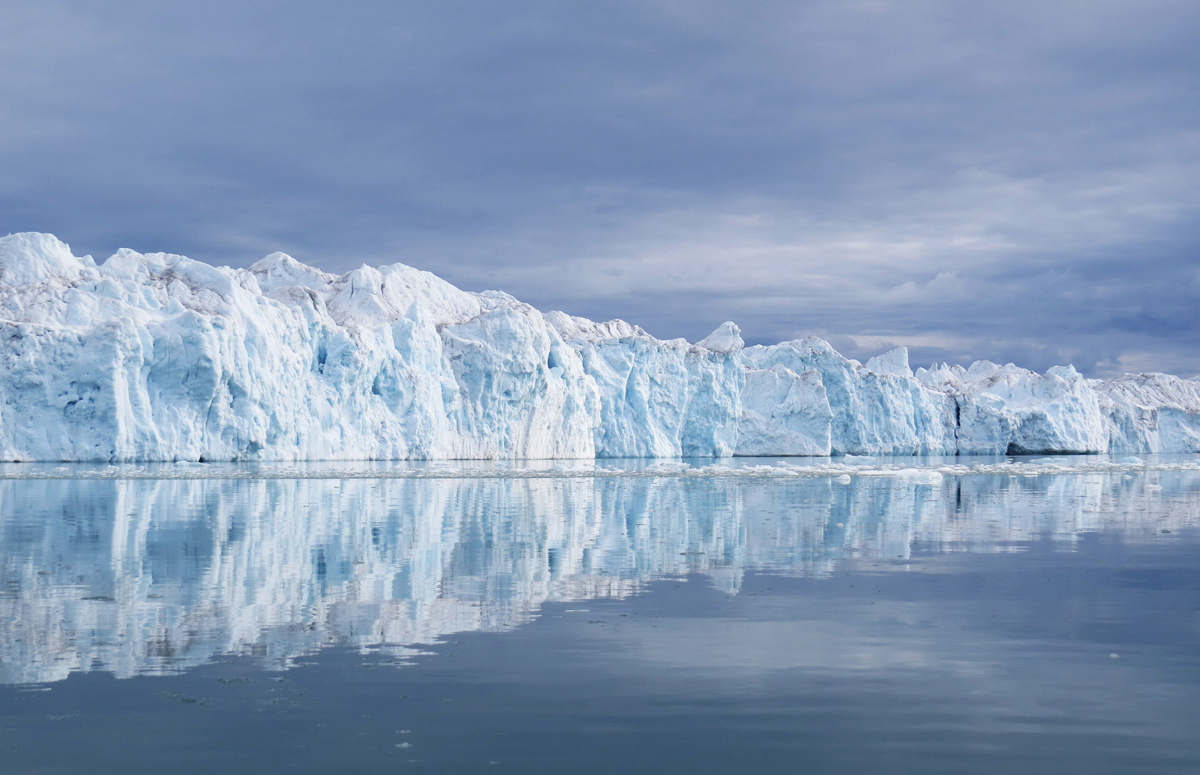
arctic ice pack Arctic Complete – (27th July – 18th August 2017)

Celia Hills enjoyed a Wildfoot Travel  trip to the Arctic recently. Responding to our call for ‘Traveller’s Tales’, Celia sent in this summary of her trip along with some excellent photos.
Now that we’ve set the scene, we’ll hand you over to Celia……..

“The trip began with everyone meeting at Longyearbyen airport in Svalbard and going on a coach tour of the town before boarding the Polar Pioneer for the start of the adventure into the Arctic.

Arctic Exploration Cruise Vessel The Polar Pioneer
The Polar Pioneer, a Finnish-built expedition cruise ship operated by the Australian cruise company Aurora Expeditions

The first exciting thing was to be briefed on safety & to do a lifeboat drill as we were leaving harbour. Trying to get into one of two small lifeboats with all 53 passengers & some crew was a challenge with huge lifejackets & little space. As there is permanent daylight at these latitudes at this time of year there was much to see already.

Huge numbers of sea birds to be seen included Fulmars, Glaucous Gulls, Little Auks, Puffins, Black Guillemots, Brunnichs Guillemots, Kittiwakes Eider Ducks & Arctic terns. As the trip progressed the numbers of some of these verged on the staggering with huge seabird cliffs bulging with adults & chicks. Less often seen were the Arctic Skuas & Great Skuas. Geese were also abundant with Pink Footed geese & Barnacle Geese the most common.

Only two days into the trip & the first of 12 polar bears was sighted. This trip was outstanding for bears with the best left to last with a sighting of a mother & cub. One encounter with a male bear on a hunting mission was deemed to be worthy of a “Frozen Planet” sequence by the guides as it had the bear stalk & attack three bearded seals over a 3 hour period.

a polar bear hunting on the arctic shoreline
Only two days into our trip & the first of twelve polar bears was sighted.

Another highlight of this trip were the glaciers & icebergs for sheer beauty of colours, size & shapes & glaciers calving when viewed from a zodiac is amazing with the sound & then mini tsunami.

History is also a strong feature of this trip with various ancient camps, huts and burial grounds of the ancient explorers & trappers.

Walrus were also a highlight with some amazing sounds  & smells in the pushing & shoving of a group of young males, while an encounter from the zodiac of a group of females & young was enchanting.

Walrus were also a highlight with amazing sounds & smells.

Tiny Arctic Foxes were a delight & some almost tame in their tolerance of close humans. One catching an unfortunate Kittiwake chick that was pushed from its nest showed nature in the raw.

A pod of over 20 Beluga whales was another  of many highlights with them cruising around the zodiacs.

Crossing the Greenland Sea from Svalbard to Greenland was mostly uneventful with birds & fog being the order of the days.

Greenland has certainly got the wow factor with glorious scenery & magnificent rock formations & colours. Scoresbysund being the most amazing place. The addition of Musk Ox in Greenland added to the wildlife total.

Apart from Longyearbyen in Svalbard the only other occupied area visited on this trip was Ittoqqortoormiit, one of the only inhabited area of east Greenland & home to 350 people.

For me one of the best experiences was on the last landing in Greenland where there were a pair of Gyr Falcons, a bird I had never seen.

To summarise this trip is difficult because there were so many highs – Polar Bear, Walrus, Arctic Fox, Musk Ox & the thousands of birds – but what made I was the staff & crew of the Polar Pioneer being so friendly & knowledgeable.

Celia Hills.”

See more of Celia’s photos in this photo gallery

[Best_Wordpress_Gallery id=”15″ gal_title=”Celia Hills Arctic Cruise Gallery”]

Check out all our Arctic cruises here

Join us on a Spitsbergen polar bear safari. Find out more here

Find out more about all our polar cruise partners here


SaveSave

SaveSave

SaveSaveSaveSave

SaveSave

SaveSave

the northern lights An incomparable coal mine experience and an impressive display from the northern lights

There can’t have been many Arctic holidays quite as enjoyable and fulfilling as that recently embarked upon by our own senior travel advisor here at WILDFOOT. Alas, in our latest blog post, her journey to Spitsbergen is coming to an end, but not without yet more great memories being made.

Day 5: Coal Mine Number 3 Visit & Camp Barentz

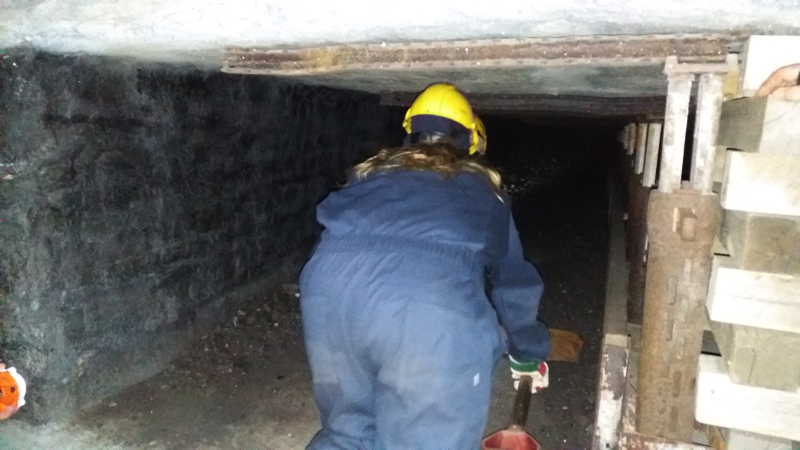
Now visiting a coal mine is not something I ever thought I would do, or would particularly want to do. Having visited one I can now confidently say that it’s somewhere I would never like to work! Crawling through narrow tunnels, deeper and deeper into a mountain, with the weight of millions of tons of rock above…then releasing the jacks holding up the roof once a coal seam has been fully mined? No thanks! We did get to crawl through a ‘fake’ tunnel which was a small taste of the experience. It was fascinating to learn though, how the miners plied their trade. They are incredibly brave and hardy – hats off to them! Before the arrival of tourism, coal mining was the main source of income for Svalbard. There are 7 mines in central Spitsbergen, only one of which is currently operational, although the industry here is highly contested with the UN and environmental organisations urging its phase out. All the more reason to preserve Mine Number 3 as a museum piece.Day 5 coal mine number 3

Day 5 Mine number 3

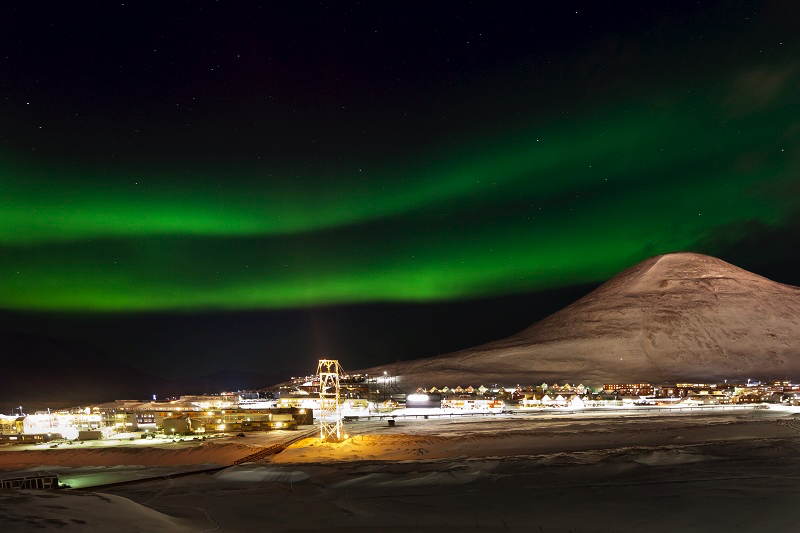
The finale of our trip was a northern lights evening at Camp Barentz. Named after William Barentz, Dutch explorer and discoverer of Svalbard, the cabin where we were to have our dinner was a rough copy of the one built by Barentz and his crew during the 11 months that they were stranded on Novaya Zemlya after their ship became stuck in the ice. With a roaring fire in the centre of the cabin, a hearty stew and chunks of bread to fill the stomach and a glass of wine in hand it was a fitting and fun end to an amazing trip. And the northern lights didn’t disappoint with their strongest display of the whole visit. Perfect!


Making new canine friends in the Spitsbergen cold

It’s one thing to go on an Arctic wildlife viewing holiday, but quite another thing for some of the animal natives to help you on your way! That’s what our travel advisor discovered on the latest day of her trip, and it’s a testament once more to some of the incredible experiences that one can have on a Svalbard break with WILDFOOT.

Day 4: Ice caving and dog sledding

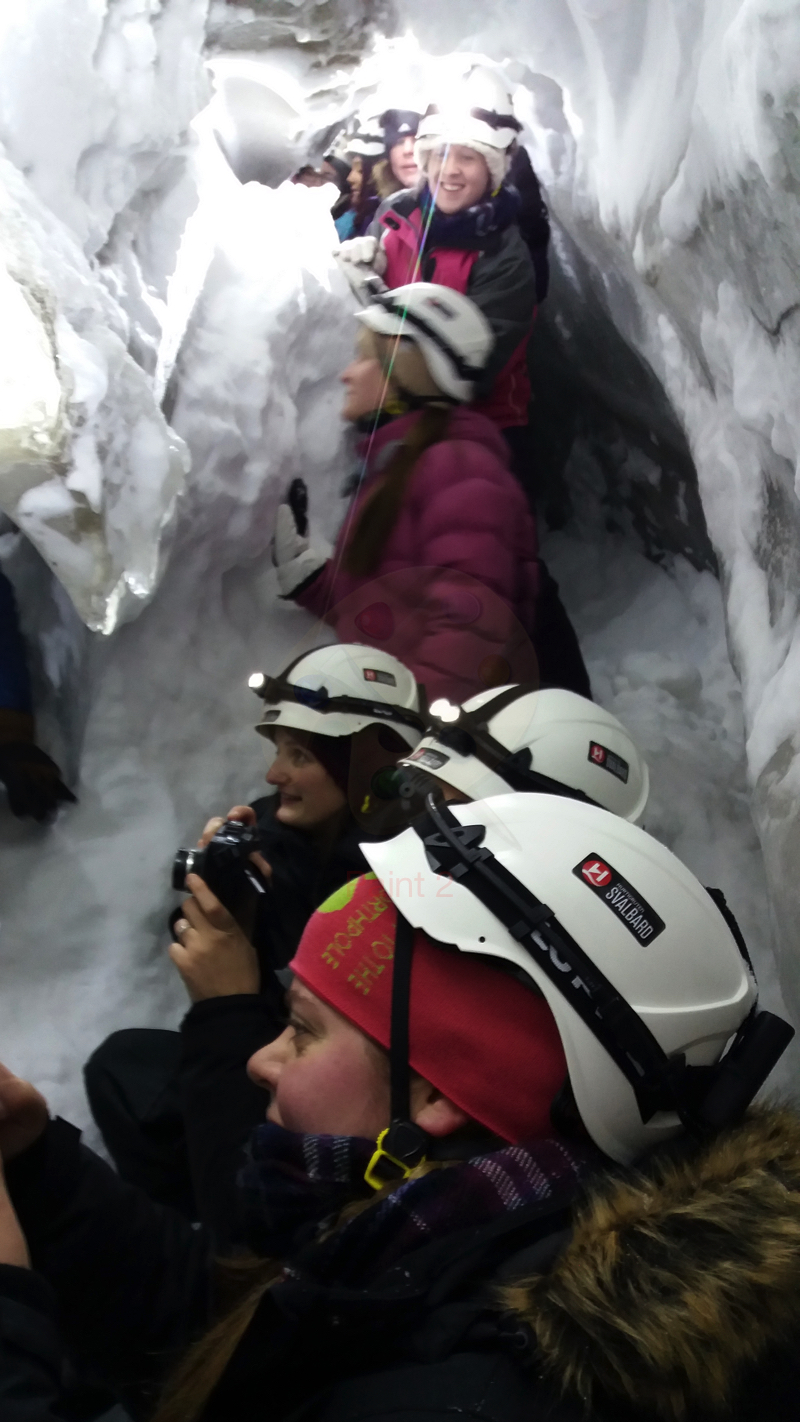
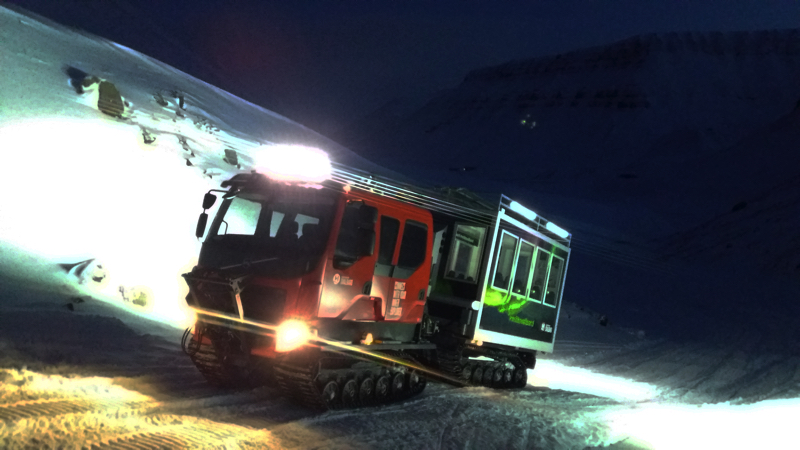
It was back outside with a vengeance today, starting with a snowcat ride up the Longyearbyen valley to an ice cave. The valley runs through the town and up into the mountains, and at its head is a glacier. Within this glacier is an ice tunnel that visitors can explore, with a fresh entrance to the cave being dug each winter to allow access. The track up to the head of the valley is steep and, needless to say, very snowy – so much so that our snow cat, even with its thick treads, struggled at one point. Once 14 well-fed members of my Arctic winter expedition group had been ejected from the vehicle and trailer, it did manage to make it up there, but only thanks to the perseverance of our indomitable driver! Inside the small igloo that has been built around the cave entrance 14 anxious faces gazed down into an icy hole. The nervous mutterings, which had been heard intermittently since the announcement of the planned ice cave visit, were somewhat quietened by the appearance of a reasonably sturdy looking metal ladder leading down into the depths. In fact, it was only a few metres to the tunnel floor and then a simple walk along a narrow channel into the cave – all that worrying for nothing! And it is stunningly beautiful down there, with the contours and colours of the ancient ice.Day 4 caving

Day 4 snowcat

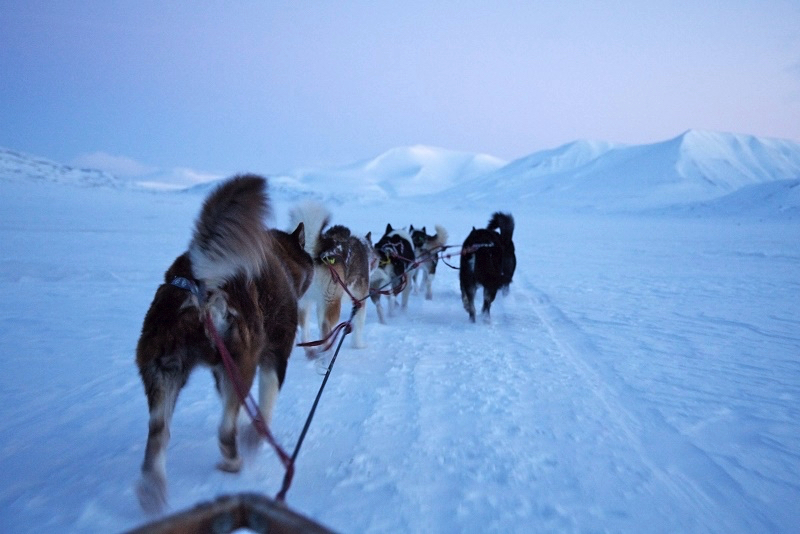
Back into the fresh air it was time for the next adventure: dogsledding. It may seem cruel to us temperate island dwellers to keep dogs outside in the middle of winter only 800 miles or so from the north pole, but in fact their preferred temperature is around -15 centigrade so for them -20 would be the equivalent of just a bit of a nip in the air. I have always wondered how huskies are able to pull heavy sleds but now I understand – they are incredibly strong. As part of our mushing experience we helped harness the dogs to the sleds and my job was to take Wasabi (a very friendly mid-sized, black and brown boy) from his pen to the harness. Huskies love to run, and once he realised he was about to go on an outing it was as much as I could do to stay on my feet as he literally dragged me from his kennel to the sled. Once given the go the dogs were off, happy to be running. It’s a wonderful thing, guiding a sled pulled by 6 beautiful huskies, through the darkness, with the northern lights flickering above, and the icy silence of the arctic winter all around. Add to that the slight frisson of fear of being eaten by a polar bear and it makes for a truly memorable experience!


A compelling museum visit and a chocolate faux pas

The latest enthralling journey that we are covering on the WILDFOOT blog took our senior travel advisor to Spitsbergen in Norway. As the story of the third day of their trip makes clear, a tailor made Arctic adventure with us is endlessly fascinating – even when it heads indoors.

Day 3: Cultural Tour + Foodie Tour

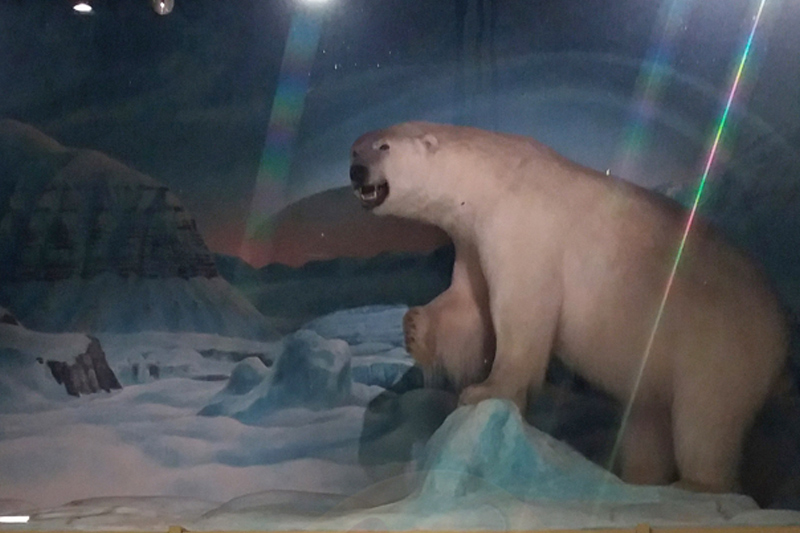
I think most of our group were quite happy to have a break from the great outdoors today, allowing our frozen bits to thaw out properly. With a population of only 2,600 and no indigenous peoples you might not expect there to be much culture or history in Spitsbergen, but the museum at Longyearbyen where we went that morning, is well worth a visit, detailing the toils, endurance and unbelievable hardship suffered by the early settlers. It’s also got its own stuffed polar bear, which I was starting to realise is de rigueur in indoor public spaces in Longyearbyen (not forgetting the airport arrivals hall, the supermarket has one, as does the Radisson Blu and at least one of the outdoor gear shops in town). Along with the continuous darkness it’s the presence of polar bears (there are more than humans there) that actually makes Svalbard different to anywhere I’ve ever been before. When leaving the town limits, it is the law that you, or your guide, must be armed with a rifle. Polar bears are extremely big and hungry and, as the information in the museum made quite clear, we are food!Day 3 Museum info about polar bears

Our next stop was a gallery showcasing art inspired by the stark beauty and incredible light of Svalbard. The gallery also had an interesting display of old maps from the days of early exploration. Although some of those maps are hopelessly inaccurate, I did stop and ask myself how I would fare trying to draw up a chart of somewhere so inaccessible. Not too well I wouldn’t think!

The day finished with the unlikely sounding ‘Taste of Svalbard’ tour. Now whilst the early settlers, and indeed the majority of inhabitants until quite recently, would have had a rather unadventurous diet, that’s not the case these days. In fact, the meals I had here were all outstanding. The main highlights of the gastro tour today however were Svalbard’s very own brewery, with its 5 speciality beers, the Polar Permaculture project (where they are trying to grow herbs and vegetables in a greenhouse) and a chocolaterie. Presented with a plate of chocolate samples I am extremely ashamed to say that I had eaten all mine before realising that the owner of the shop was intending to talk us through the subtle taste of each, one by one. Very embarrassing…Day 3 spitsbergen brewery

Snowmobiling on Spitsbergen in the dark of an Arctic January

Arctic cruises to Svalbard and the Norwegian archipelago’s largest island of Spitsbergen have always been in high demand here at WILDFOOT, and the story of our travel advisor’s latest trip to the region helps to demonstrate precisely why. Brace yourself for her retelling of the first two days of yet another incredible journey.

Spitsbergen 2017

When I was told that I would be travelling to Svalbard in January my first thought was ‘you can travel to Svalbard in January?!’ With the capital, Longyearbyen, having a latitude of 78.22 degrees north, during the winter months the archipelago is in the grip of the polar night, when the sun never comes near the horizon, let alone crossing it! ‘What activities could you possibly do in the dark?’ I thought. I was about to find out… 

Day 1: Arrival

Our flight into Longyearbyen, the main town on Svalbard’s main island of Spitsbergen, arrived in the early hours of the morning so of course it wasn’t at all strange that it was dark! There to meet us at the luggage carousel was the first of what turned out to be many stuffed polar bears in Longyearbyen.

Day 1 Polar bear at Longyearbyen airport

Stepping out of the airport the temperature was decidedly fresh but not as bitterly cold as I was expecting – perhaps because the air is so dry? Checking into our accommodation, the Coal Miner’s Cabins, my main concern was: would it be warm enough? I needn’t have worried; it was toasty!

Day 2: Snowmobiling

Following a hearty and delicious breakfast we set out on the first of our activities: snowmobiling. With the outside temperature -21 centigrade, and an approximate distance of 140kms to be covered, it was definitely a case of ‘in at the deep end’…

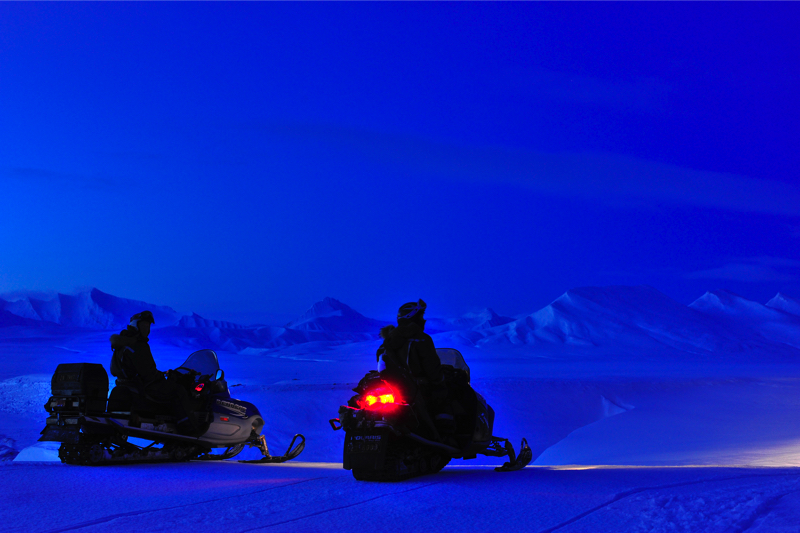
Once fully kitted up for the cold we had a brief introduction to snowmobile handling and then were off! Riding a snowmobile is pretty easy actually – like riding an automatic scooter but more stable – there aren’t any gears and you don’t really even need to use the brakes, just ease off the gas if you want to slow down. Our snake of snowmobiles twisted off into the darkness of the Advent Valley, a line of light in the black of the polar night. In late January, in fact there is a little light in the sky; for around an hour and a half at midday the sky turns from black to a beautiful dark blue, with just enough light to hint at the shapes of the magnificent snow covered mountains lining both sides of the valley. I can’t deny that the whole experience left me a tad chilly (multiple layers, balaclava and heated handlebars notwithstanding) however it was utterly magic to experience the wildness of such a pristine and deep-frozen landscape.

Find out more about or Arctic Expedition Cruises here

SaveSave

SaveSave

No shortage of variety as I continue my fun Russian High Arctic cruise

In an earlier blog post, John recalled his enjoyable time spent in Longyearbyen, the largest settlement on the Norwegian Svalbard archipelago. However, that was only the start of his journey to Franz Josef Land. Here is a follow-up account of what else he came across on the way there.

Day 3

An undoubtedly cosmopolitan group of passengers

I’ve had a fun start to my expedition in the Russian High Arctic, where the Sea Spirit is the ship transporting me. My experience certainly leads me to recommend Arctic cruises in the Svalbard, but my fellow passengers and I had much more than the ship itself to check out.

On the first Friday of my journey, following the previous night’s briefings and safety drill, there was our first dinner. There were various nationalities on board, including Germans, Australians, Kiwis, Israelis, Dutch, Swiss and other Brits.

Even though we were tired, it was really quite difficult going to bed because of the bright sunlight. I have been there before in the midnight sun, but still strange! We also saw our first whale, a humpback blowing and then diving, showing a beautiful fluke.

Close encounters of the bird kind

The next day, we were sailing at a speed of 15 knots up the north-western coast of Spitsbergen and into the Barents Sea, then across to the archipelago of Franz Josef Land.img_2583

We made one stop on the way, off a small island called Moffen, where we saw a haul-out of walruses about 300 yards distant. We also saw a few seabirds, including some puffins and Brünnich’s guillemots. Otherwise, it was a day of briefings, lectures and food.dscn4540

After dinner, we had a call that we were passing the last point of land in Svalbard, Christian XII Island. The snow-capped mountains were now receding into the distance and the sun continued to shine brightly as we thought of sleep. We were now higher than 80 degrees north!dscn4551

What did I get up to in Franz Josef Land?

In my story so far, we have only just reached Franz Josef Land, which is administered by Russia. However, it won’t be long before I tell you a lot more about what I saw and did on this Arctic archipelago. I can’t wait!


A great time in Longyearbyen, the Norwegian Svalbard’s capital

In the summer, John from WILDFOOT travelled with his wife to Franz Josef Land in the Russian High Arctic on the expedition ship Sea Spirit. This is an account of his incredible journey, which took in various attractions of our Arctic cruises to Spitsbergen.

Days 1-2

A very early and quiet start

Upon arriving by flight in Longyearbyen at 2am, the first thing that struck us was the fact that it was still daylight. This was truly the land of the midnight sun! The airport bus calls at all of the town’s hotels, which are used to late arrivals.

As breakfast was not until 10am, we had a bit of a lie-in before going out exploring. Longyearbyen is in a valley on Isfjord’s shore. Originally a mining settlement, Longyearbyen still has remains of timber cranes, pulley systems and shaft entrances on its hillsides. At the time of year we visited, it was all very barren, with patches of snow on the higher ground.img_2543img_2547

There is plenty of beauty to behold in Longyearbyen

We walked for miles around the outskirts of town and went to a gallery, where we met an artist who paints sketches based on local wildlife and artefacts. We also saw some amazing monochromatic oils – including almost pure white snow and ice scenes, some also with an impression of a mountain or a feint pink sunrise or a night scene with a moonlit icy hillside.

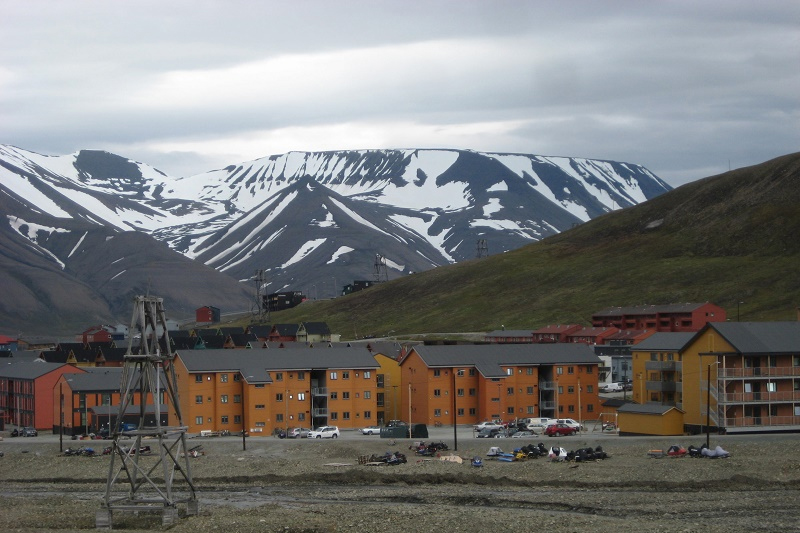
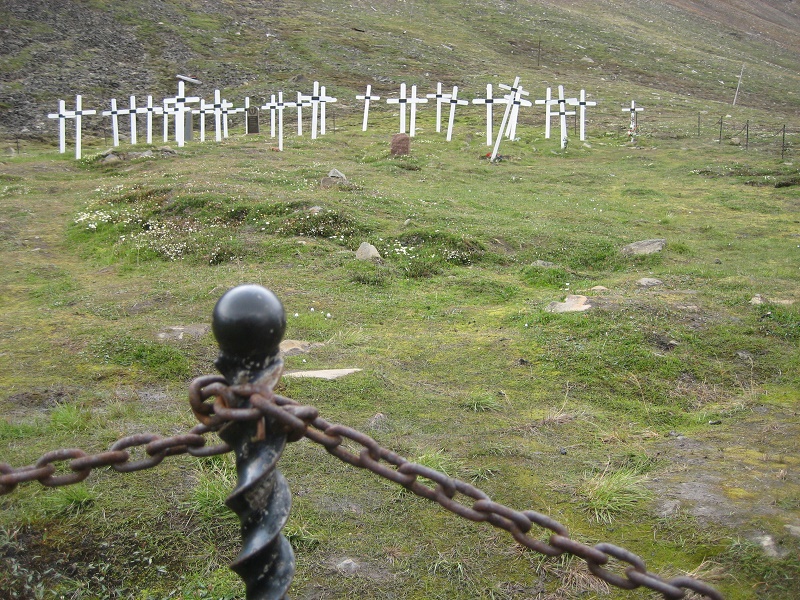
On the hillside near town, there is a small forlorn cemetery with a few graves marked with simple white crosses. We wandered here and looked across the town and the fjord at brightly coloured modern buildings imposed on a harsh unchanging landscape. img_2548

The museum was very interesting, if overrun by tourists. That day, ours was one of just three boarding expedition ships, each with about 100 or so passengers. However, in port that morning was a big German cruise ship with about 1,000, and this will probably be their only landing in Spitsbergen, so, for them a visit to the museum is a highlight.

Our Arctic adventures didn’t end here!

Then, having skilfully avoided the expensive craft and clothing shops, we set off for our Zodiac transfer out to our ship, the Sea Spirit, which was at anchor in the fjord. As for where it took us – we will detail much more about that in a follow-up blog post.


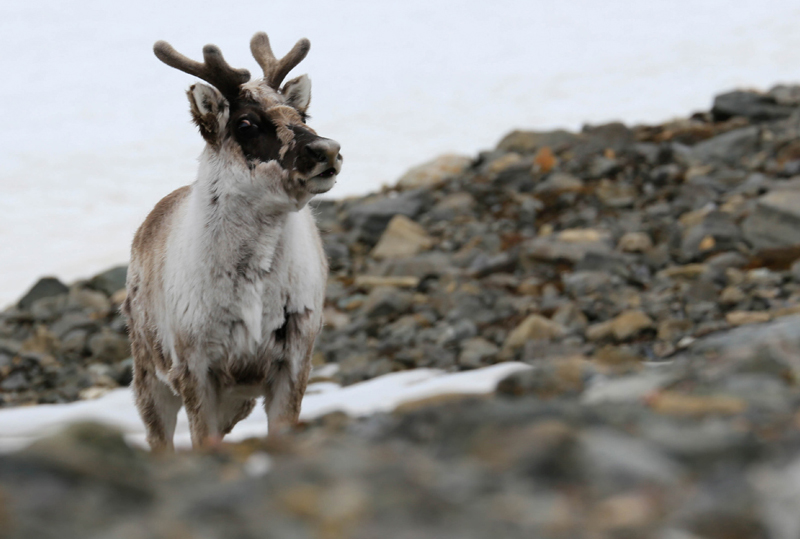
Rub shoulders with reindeer in Spitsbergen

Spitsbergen is one of the most interesting destinations in the northern hemisphere. It is part of Svalbard and is its only permanently-populated island. Svalbard belongs to northern Norway, with Spitsbergen being the 36th-largest island in the world. It also borders the Arctic Ocean, as well as the Norweigan and Greenland Seas. Here at WILDFOOT, we can assist if you have ever considered Arctic cruises in Spitsbergen.

In the 17th and 18th centuries, Spitsbergen was a whaling base before it became a hotbed for coal mining. It is now heavily associated with both tourism and research, with residents and visitors travelling from settlement to settlement via boats, aircraft and snowmobiles. It is home to a vast range of seabirds as well as reindeer, Polar bears and marine mammals. Spitsbergen is also where you can find six national parks, and is loved for its mainly untouched character.

The island also features various mountains, fjords and glaciers. So wild and remote is this part of the Arctic, that there are 3,000 polar bears roaming around Spitsbergen. As there are no roads connecting the settlements, Spitsbergen is also necessarily home to around 4,000 snowmobiles. There are no sunrises for four months, between October and March, and when the sun finally does resurface, its return is marked by Solfestuka, a weeklong celebration that consists of parties, exhibitions and music.

Longyearbyen is one of the busiest parts of the region, a place where reindeer rub shoulders with humans on a regular basis. Spitsbergen is also known as the home of the world’s most northernmost gourmet restaurant, which has more than 20,000 bottles of wine and has received the equivalent of the Michelin star for the quality of its cuisine.

Here at WILDFOOT, we’re waiting to hear from you if you’re interested in exploring Spitsbergen. We offer a range of unique packages that allow you to experience the glory of Spitsbergen and see it with your own eyes. Our team members are experts when it comes to what the region has to offer and are keen to help you to plan the perfect expedition to Spitsbergen.

We can even take you around Spitsbergen by sailing ship, so why not enquire today about what might just be a journey never to be forgotten?