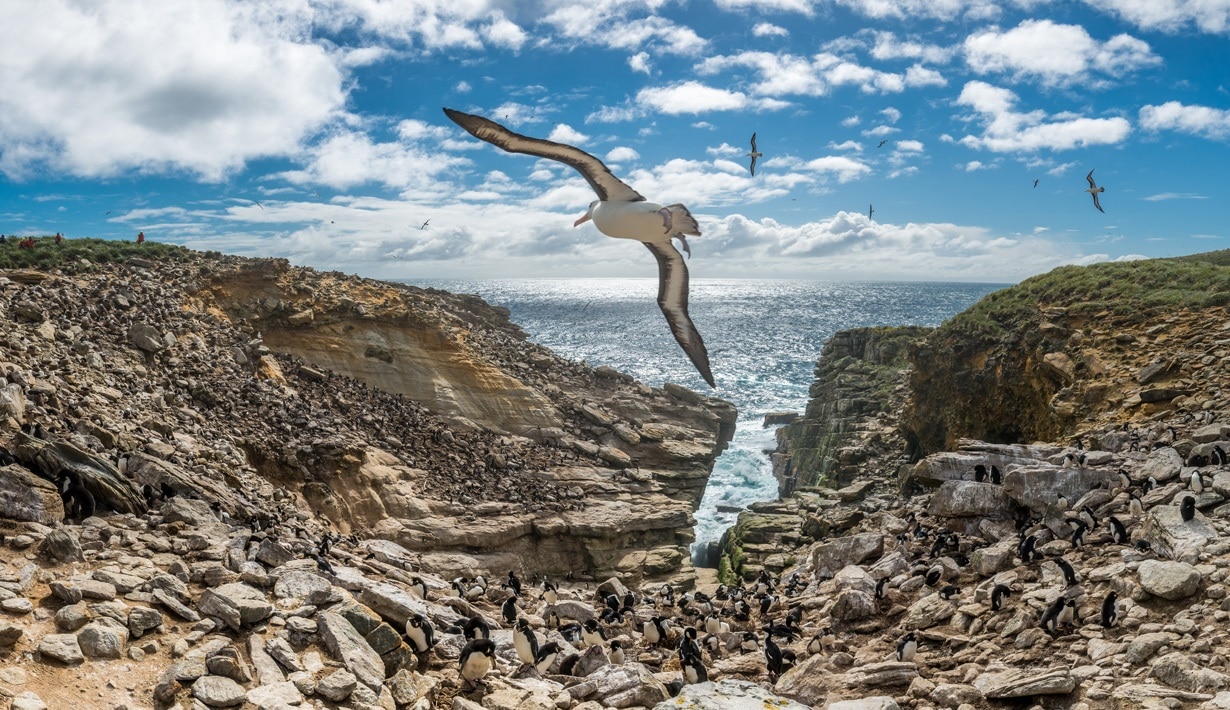
 Antarctica’s Big Five: The Wildlife You Came to See
Nobody travels to the end of the world for the scenery alone. They come for the moment a humpback surfaces alongside the Zodiac, or the first time a colony of sixty thousand penguins comes into view and, more memorably, into smell.
At Wildfoot Travel, three decades of guiding travellers to the world’s great wilderness destinations has taught us that wildlife is what people remember, and what they are really booking when they choose an Antarctic expedition.
Our specialists have watched leopard seals patrol the edge of a gentoo colony, spent Drake Passage crossings with albatross holding station off the stern, and been close enough to a surfacing humpback to hear it breathe. We know which encounters a Peninsula voyage can realistically deliver, which ones need South Georgia, and which require a specialist itinerary altogether.
The phrase ‘Big Five’ comes from African safari, where it referred originally to the five animals considered most dangerous to hunt on foot. Antarctica has no such tradition and no official list, so what follows is our own.
Here is our honest, unfiltered guide to the five encounters that define a voyage south, what makes each one worth the journey, and how likely you actually are to see them.
1. Penguins
Penguins are the reason most people come, and the one animal on this list you are all but certain to see.
Around forty species of bird breed in the Antarctic region, but only four penguin species live on and around the continent year-round:
- Adéli
- Emperor
- Chinstrap
- Gentoo
Along the Antarctic Peninsula, where the majority of voyages spend their time, gentoo and chinstrap colonies are abundant and easily reached, and Adélies breed further south than any other penguin.
The gentoo is worth watching underwater if you get the chance. They are the fastest swimming birds in the world, reaching around 35 kilometres per hour, which is roughly four times the pace of an Olympic freestyle swimmer.
Above water they are considerably less elegant, and the business of stealing nesting pebbles from a neighbour while the neighbour is stealing from someone else is one of the great comic spectacles of the south.
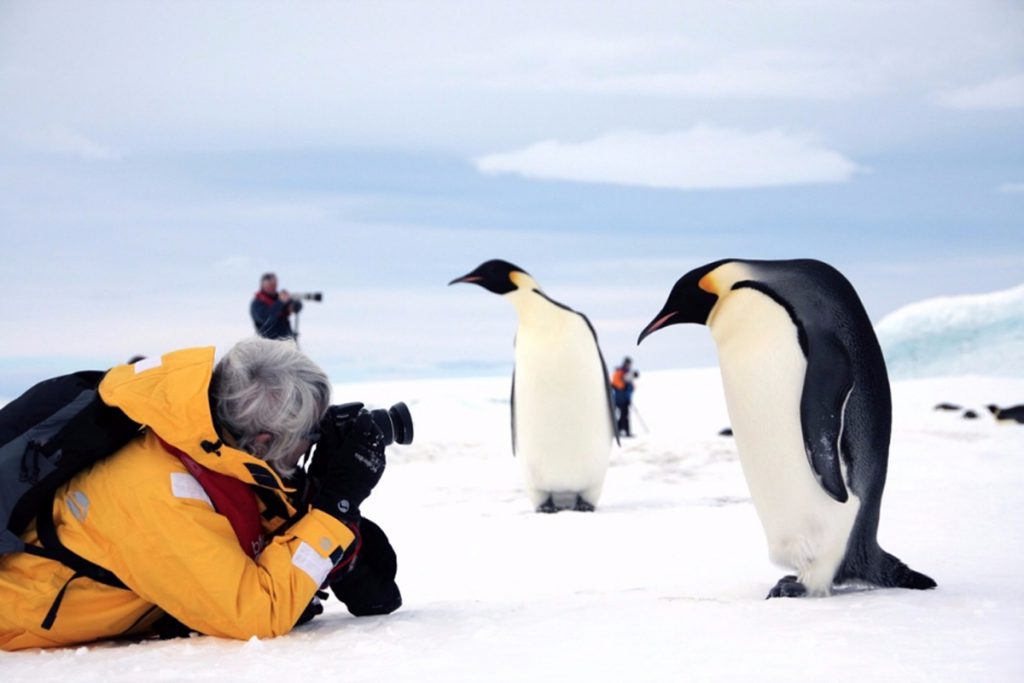
Two species ask more of you. The emperor penguin, the largest of them all and the only penguin that breeds through the Antarctic winter, nests on fast ice deep in the Weddell and Ross Seas. Reaching a colony usually means a specialist itinerary with helicopter or icebreaker support.
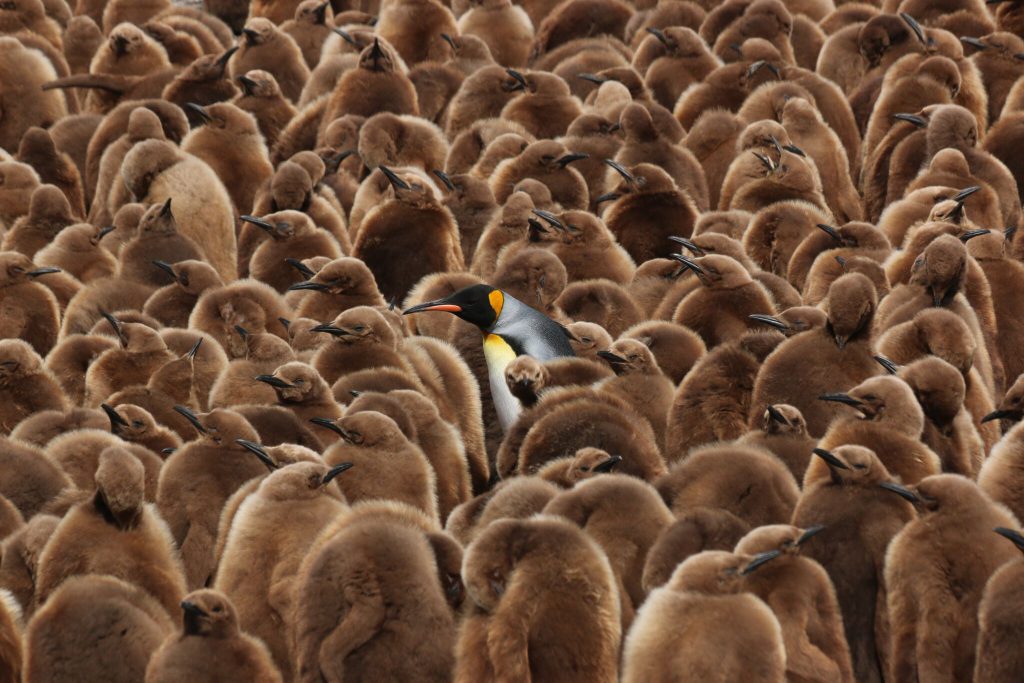
The king penguin, meanwhile, is a South Georgia animal, and Saint Andrews Bay holds the largest king colony in the world. Counts vary considerably depending on method and year, with estimates ranging from around 125,000 to 250,000 breeding pairs. If penguins in overwhelming numbers are what you want, South Georgia rather than the Peninsula is where you will find them.
Likelihood: Effectively guaranteed on any Peninsula voyage. Emperors require a dedicated itinerary. Kings require South Georgia.
2. The Humpback Whale
The humpback is the most abundant baleen whale around the Antarctic Peninsula and the one you are most likely to meet at close quarters.
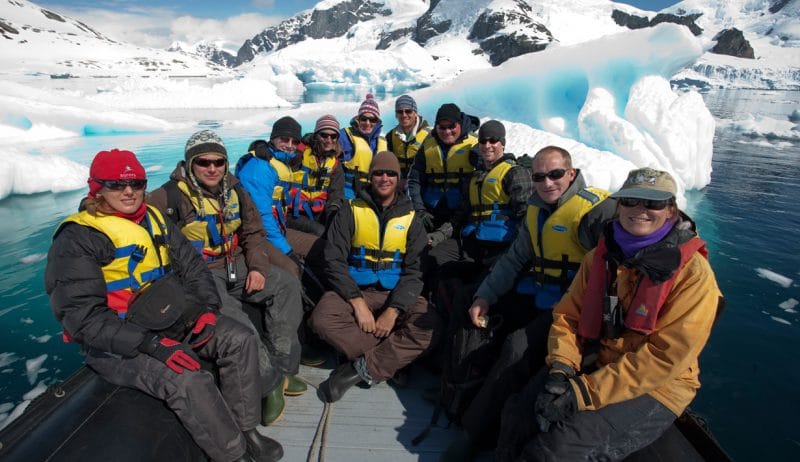
They arrive through December after migrating from tropical breeding grounds, and by late season they have spent months feeding on krill and become notably unbothered by small boats. This is why February and March produce the encounters people talk about afterwards, where a whale surfaces beside a Zodiac and simply stays there, turning to look.
Their recovery is one of the genuinely good news stories in the Southern Ocean. Humpback populations around the Antarctic have shown annual increase rates of between 7 and 12 per cent, and several Southern Hemisphere populations are now approaching their estimated pre-whaling numbers.
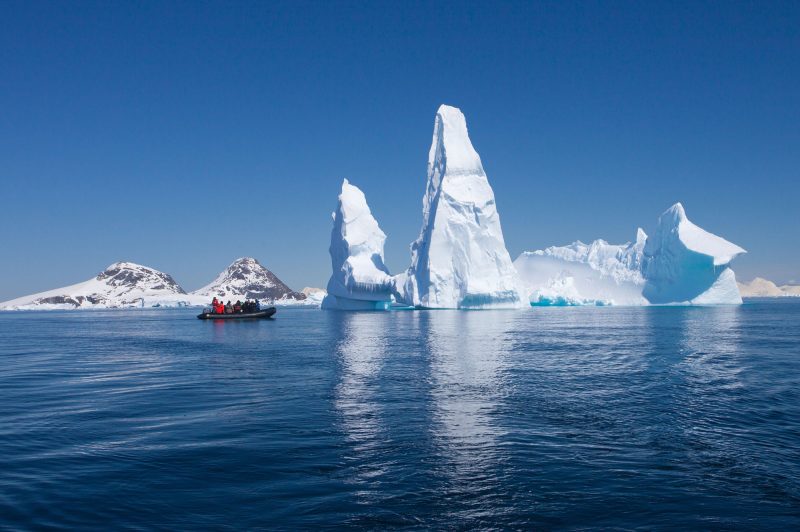
The fin whale deserves a mention alongside them, partly because it is the second longest animal on earth after the blue whale, reaching over 20 metres.
More than 720,000 were killed in the Southern Hemisphere during the whaling era, reducing the population to roughly one per cent of its original size, but the species was downlisted by the IUCN from Endangered to Vulnerable in 2018 and now numbers around 100,000 mature individuals worldwide.
Large feeding aggregations have returned to historical grounds around Elephant Island and South Georgia, which researchers read as a sign of genuine recovery.
Likelihood: Very good from December onwards, excellent in February and March.
3. The Leopard Seal
If the humpback is the encounter that moves people, the leopard seal is the one that unsettles them.
They are built unlike any other seal in the region, with a long serpentine body, an oversized head and a jaw they can open to nearly 160 degrees. Females are the larger sex, reaching around 3.8 metres and up to 590 kilograms, while males run to roughly 3 metres. Only the orca preys on them.
Their reputation as penguin hunters is earned but incomplete. Leopard seals do take penguins, and the process is not for the squeamish, since they typically thrash the bird at the surface to separate the blubber-rich skin before eating it and leaving the rest for skuas and petrels. What surprises people is how much krill they eat. Their rear molars interlock to form a sieve, allowing them to filter feed in much the same way a crabeater seal does, and krill can make up a substantial part of their diet alongside fish, squid and the pups of other seals.
You will most often see one hauled out on an ice floe, apparently asleep and entirely indifferent to the ship.
Likelihood: Good. Regularly encountered on Peninsula voyages throughout the season, with February and March the most active months for hunting behaviour.
4. The Orca
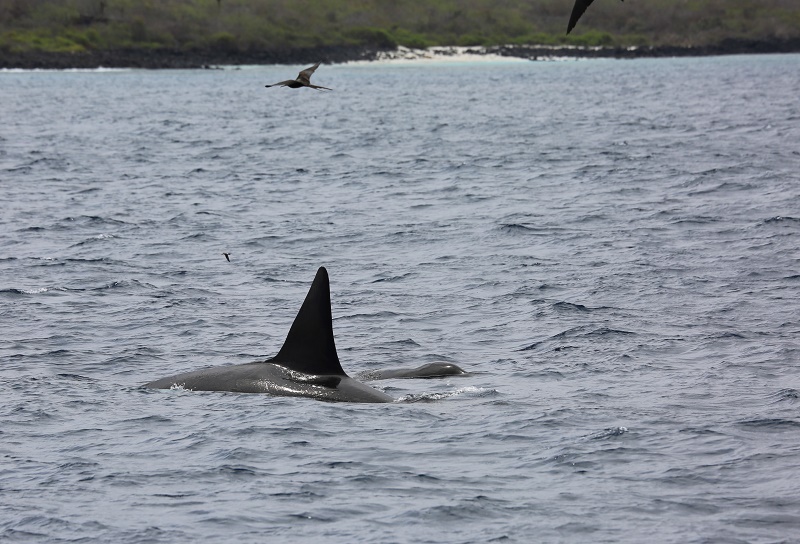
The orca is the least predictable animal on this list and the most rewarding to find.
Antarctic waters hold five described ecotypes, which are populations distinct enough in size, markings, diet and even dialect that researchers treat them separately. Type A hunts Antarctic minke whales and southern elephant seals, and its males reach around 9.2 metres.
The larger form of Type B specialises in seals, particularly Weddell seals, and is the ecotype responsible for wave-washing, a coordinated technique in which several animals swim in formation to generate a wave that sweeps a seal off an ice floe.
The smaller Type B form takes penguins and fish. Type C, found mainly in the Ross Sea, is the smallest killer whale known anywhere, with males reaching about 6.1 metres, and specialises in Antarctic toothfish. Type D inhabits sub-Antarctic waters and remains poorly understood.
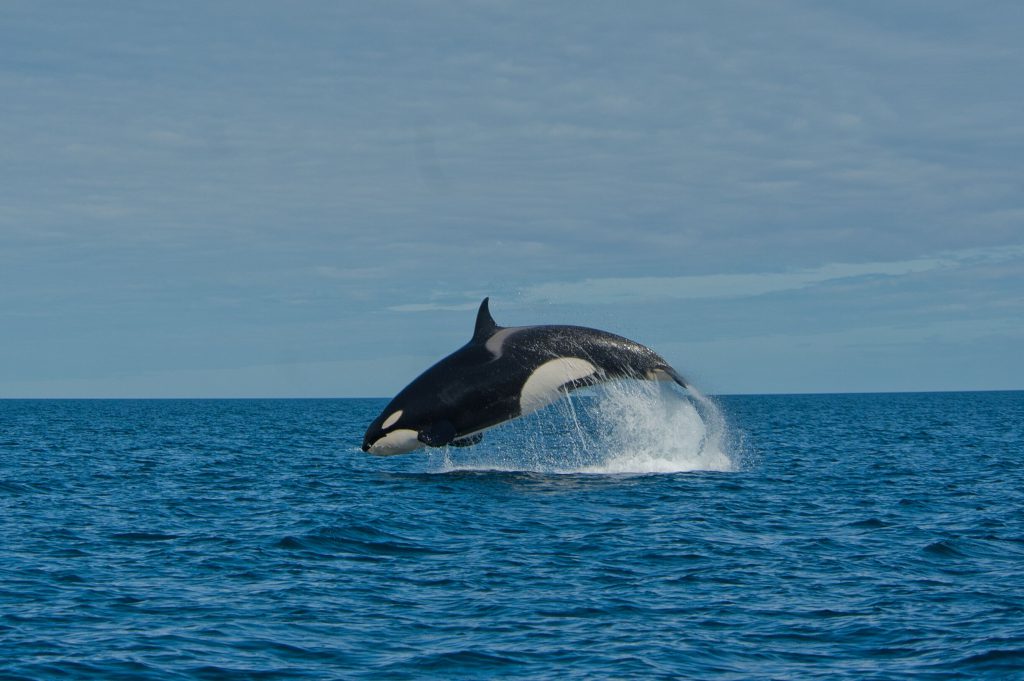
Knowing which one you are looking at turns a good sighting into a memorable one, and any decent expedition team will tell you on the spot.
Likelihood: Variable and never guaranteed. Sightings are opportunistic rather than scheduled, which is part of why they are prized.
5. The Wandering Albatross
The wandering albatross is the animal you meet before you arrive, and the reason experienced travellers rather enjoy the Drake Passage.
It has the largest wingspan of any living bird, averaging around 3.1 metres and reaching 3.5 metres, with the largest verified measurement close to 3.65 metres. That wingspan allows a technique called dynamic soaring, where the bird extracts energy from the difference in wind speed at different heights above the waves and covers enormous distances with almost no flapping.

Foraging trips can last days and cover thousands of kilometres. A bird nesting on South Georgia may travel as far as the waters off Brazil and Uruguay to feed.
They are also slow, faithful and vulnerable. Pairs mate for life, raise a single chick every two years, and the chick does not fledge until it is over a year old. The world population is around 26,000 birds and the species is listed as Vulnerable, with longline fishing the principal threat, since the birds take baited hooks and drown.
On a South Georgia itinerary you can visit Prion Island and see them on the nest, which is a different experience entirely from watching one shadow the ship.
Likelihood: Very good across the Drake Passage and around South Georgia and the Falklands.
Being out on deck, I was fascinated watching various species of albatross swoop around the ship’s wake – an efficient manoeuvre the onboard ornithologist called “dynamic soaring”. They glided so gracefully, barely needing to flap a wing, reading the different wind speeds just above the waves to gain lift and speed almost for free. What struck me most was learning that these birds actually favour choppy, rough seas over calm ones – the stronger the wind gradient, the more free energy they can harvest, so a swell that has us holding onto the railings is exactly what an albatross is hoping for. It was incredible to think they were feasting on the nutritious meal the ship was stirring up from below – krill, squid and small fish pushed to the surface in our wake – covering vast distances for so little effort. Truly remarkable birds, built to thrive in exactly the conditions most of us find hardest to handle. It completely changed how I think of the Drake Passage – not just a stretch of ocean to cross, but a feeding ground alive with birds that had followed us halfway from the world’s edge – James Turner, Wildfoot Travel
Beyond the Five
Five is an arbitrary number, and two absences from any such list are worth correcting.
The first is the animal that makes all the others possible. Antarctic krill is a shrimp-like crustacean around six centimetres long, weighing up to two grams, and it is the keystone species of the entire Southern Ocean. CCAMLR puts the total biomass at roughly 379 million tonnes, which outweighs the whole of humanity, and swarms can reach densities of tens of thousands of individuals in a single cubic metre of water.
More than half of that biomass is eaten every year by whales, seals, penguins, squid and fish, then replaced through reproduction and growth. Every animal in this article depends on krill, either directly or one step removed. Its abundance along the West Antarctic Peninsula has been declining as sea ice retreats, which is arguably the most consequential wildlife story in the region and the least visible from the deck of a ship.
The second absence is the rest of the seals. The leopard seal earns its place on reputation, but the crabeater is the most numerous seal on earth, running to several million animals, and despite the name it eats almost nothing but krill. Weddell seals haul out on fast ice and are among the most commonly encountered on Peninsula landings.
And if you sail to South Georgia you will meet southern elephant seals, the largest seal on the planet, with bulls weighing several tonnes, alongside fur seals in numbers that can make a beach genuinely difficult to walk along.
When to See What
The Antarctic season is short and each month favours different animals. This summarises the guidance above.
| Species | Best months | Where | Likelihood |
| Penguins | Whole season; chicks from late December | Peninsula for gentoo, chinstrap, Adélie; South Georgia for king | Effectively certain |
| Humpback whale | February and March | Peninsula waters | Very good late season |
| Leopard seal | Whole season; most active February to March | Pack ice and floes, Peninsula | Good |
| Orca | Whole season | Peninsula and Weddell Sea; Type C in the Ross Sea | Opportunistic, never guaranteed |
| Wandering albatross | Whole season; nesting visible November to March | Drake Passage, South Georgia, Falklands | Very good |
For a fuller breakdown of how the season changes from October through to March, see our month-by-month guide to the best time to visit Antarctica.
Where You Go Decides What You See
Itinerary matters more than luck for four of these five animals.
A standard Antarctic Peninsula voyage will deliver penguins, humpbacks, leopard seals and albatross across the Drake Passage. Adding South Georgia and the Falklands changes the trip substantially: king penguin colonies in the hundreds of thousands, elephant seals and fur seals in vast numbers, and nesting wandering albatross on Prion Island. It adds roughly a week to the voyage and a significant amount to the fare, and for wildlife it is the single best upgrade available.
Emperor penguins sit outside all of this and need a dedicated Weddell Sea itinerary. Our Antarctica route options page sets out how the different voyages compare, and the vessels guide for Antarctica covers which ships carry the ice class and Zodiac capacity to make the most of a sighting when it happens.
Watching Responsibly
Every encounter described here happens under rules, and they are stricter than most first-time visitors expect.
IAATO, the International Association of Antarctica Tour Operators, sets the baseline. Visitors keep at least five metres from wildlife on land or ice, and that includes camera lenses.
Some species and situations require considerably more, and site-specific guidelines override the general rule. For whales, small boats stay roughly 30 metres off and ships around 100 metres. Landings run with a minimum of one staff member to every twenty guests.
The distances are a floor rather than a target. The working principle is simpler than any number: if an animal changes its behaviour because of you, you are too close.
Animals always have right of way, the penguin highways running between a colony and the water are never to be blocked, and an inquisitive penguin that closes the gap of its own accord is doing something you are entirely allowed to enjoy, provided you stay still and do not reach out.
Since 2024 there has been an additional layer. Highly pathogenic avian influenza, H5N1, reached the Antarctic Treaty Area in February of that year, carried south by migrating birds rather than by human activity.
It has since been confirmed in gentoo and king penguins, wandering albatross, southern giant petrels, skuas and several seal species across the sub-Antarctic and the northern Peninsula. IAATO closes affected sites to its members, expedition teams assess colonies for signs of infection before anyone steps ashore, and decontamination between landings is now routine whether or not the virus has been detected at a site.
The practical consequence for travellers is that a planned landing can change at short notice, and a good expedition leader will explain the reason rather than simply announcing a new plan.
Frequently Asked Questions
Am I guaranteed to see penguins in Antarctica?
In practical terms, yes. Any Peninsula voyage in season will visit multiple colonies, and gentoo, chinstrap and Adélie penguins are abundant. No reputable operator guarantees a specific species, but penguins are as close to certain as Antarctic wildlife gets.
What is the best month for whale watching in Antarctica?
February and March. Humpbacks have been feeding for months by then, the sea ice has retreated, and the animals are often relaxed around Zodiacs. Earlier in the season you will see whales, but fewer of them and usually at greater distance.

Can you see emperor penguins on a normal Antarctic cruise?
No. Emperors breed on fast ice in the Weddell and Ross Seas, well away from standard Peninsula routes. Seeing them requires a specialist voyage, usually involving helicopter or icebreaker support, and these sail at specific times of year.
Are leopard seals dangerous to visitors?
Encounters from a Zodiac are safe and closely managed by expedition staff. Leopard seals are formidable predators and are treated with respect, but incidents involving people are extremely rare. Your expedition team will set the distance and you should follow their direction.
What is the difference between the Antarctic orca types?
Five ecotypes are described, differing in size, markings, diet and vocalisations. Type A hunts minke whales and elephant seals, large Type B specialises in seals and uses wave-washing to dislodge them from ice floes, small Type B takes penguins and fish, Type C is the smallest orca known and feeds on Antarctic toothfish, and Type D lives in sub-Antarctic waters.
Could avian flu affect my trip?
It can affect individual landings rather than the voyage as a whole. H5N1 reached the Antarctic Treaty Area in 2024, and IAATO closes affected sites to its members while expedition teams assess colonies before going ashore.
Voyages continue to operate normally, but flexibility is built into every itinerary and a site may be swapped at short notice. Your operator will brief you on biosecurity, which includes scrubbing and disinfecting boots between landings and taking no food ashore.
Where can I see king penguins?
South Georgia. Saint Andrews Bay holds the largest colony in the world, with counts ranging from around 125,000 to 250,000 breeding pairs depending on survey method and year, and Salisbury Plain is another major site. King penguins are not found on the Antarctic Peninsula.
Talk to Us
Wildlife is the reason people go south, and the itinerary you choose decides most of what you will see.
The difference between a Peninsula voyage and one that takes in South Georgia is not a matter of a few extra days. It is a different set of animals entirely.
We have made these journeys, watched these encounters happen, and know which months, which routes and which ships give you the best chance at the ones you care about most.
Get in touch with the Wildfoot Travel team, or browse our Antarctica cruises to see what is sailing.