A Day in the Life from Expedition Leader Abbey Weisbrot
What inspired you to become a Polar Expedition guide?
My deep love and passion for wild places drew me to the polar regions. Experiencing the vast and powerful landscapes inspired me to dedicate my career to facilitating deep connections to the power of the wild.
What does a typical day onboard with Quark Expeditions look like?
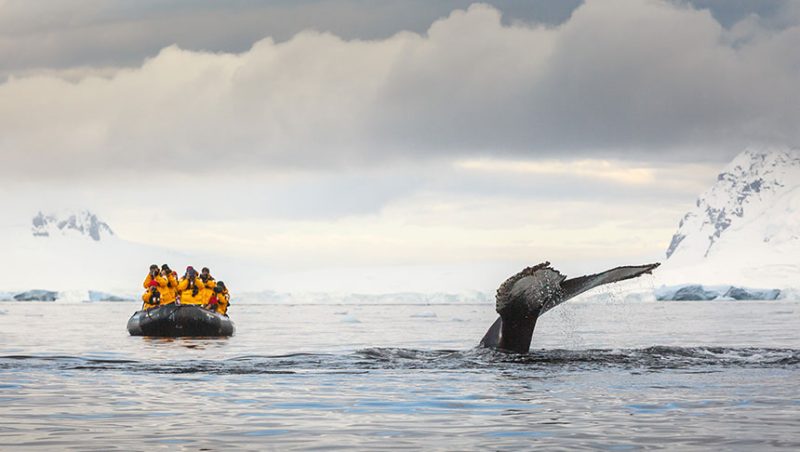
The very nature of being on an expedition means that there is no typical day, which is part of the beauty and adventure of the experience. The spirit of adventure on our voyages is such that we are open to and seeking opportunities as they arise, which sometimes means we deviate from the plan to embrace the moment. I love working for Quark Expeditions because one of our main goals is to continually explore, which we do from various platforms, from ship to shore to sky. When weather and logistics permits, we may seek multiple off-ship excursions in different locations in each day. The timings of each day will very much depend on weather, distance, speed, ice and transit conditions, and a variety of other factors that impact the day. In every day we’re in the polar regions, one element remains consistent –spend time outdoors embracing the nature around us!
How would you describe Antarctica and the Arctic to someone who has never been?
The Arctic and the Antarctic have some commonalities, however they are also very unique destinations. Both polar regions are spectacular, they offer opportunities to connect to remote and fragile ecosystems; they are visually stunning, and with wonderful nature and wildlife. The Arctic is vast and can be very different across the span of the north. It’s full of deep cultural knowledge and traditions. For me, one of the joys of exploring the Arctic is the honour we have of connecting with and learning from those who have inhabited the land for generations. The Arctic also has distinct wildlife from the Antarctic, with Polar Bears, Walrus and many more. The Antarctic is dramatic and humbling in its grandeur. It is home to some research stations and an abundance of wildlife, including various species of penguins, seals, whales and much more. Both polar regions are special parts of the world that hold distinct appeal and are well worth experiencing.
Can you tell us about your biggest wow moment in Antarctica or the Arctic?
It is difficult to capture in words the feeling associated with wow moments. As I reflect on nearly a decade of polar travel, I feel it almost overwhelming to try to select just one or two moments. I do, however, have a soft spot for those late season Antarctic sunsets. There is a time in the latter half of the season, where the sun actually begins to set and the duration of the sunset can linger for seemingly hours due to its southern latitude. There’s a special colour range of soft pink, purple and blues unlike anywhere else in the world that I’ve ever experienced. Capping off a full day exploration and wild glory with an Antarctic sunset certainly captures my heart and my memory.

What is your favourite thing about working in the Polar regions?
One of my favourite elements of working in the polar regions is how the type of travel supports the creation of a community of shared adventurers. Each voyage is so incredibly unique, one never replicating another, and that uniqueness means that each voyage holds very specific energy and creates a specific community. I love when our guests are relaxed, chatty, and interested to learn more about each other’s adventures. I feel that creating these connections to people helps our guests hold on to the memories of the experiences in a beautiful way.
Why is the Expedition Team so important to the overall guest experience in the Polar regions?
The polar regions are wild and unpredictable environments. It’s what makes them so beautiful, and makes them also a challenge to guide in. As a Polar guide we not only hold knowledge on the area, but also specific training on environmental considerations specific to each location. Site familiarity, and time-based experience provides an important element to safety and decision-making in the polar regions. Each season, I learn more, and continue to be more humbled by the power of the polar regions. Each season I bring forward more knowledge from past seasons to help facilitate a greater connection to the environment, and this experience also help us read and navigate through the terrain. A team that is highly trained, highly skilled, highly knowledgeable, approachable and fun makes the places come alive and ultimately contributes to an extraordinary guest experience.

If you could give one piece of advice to guests coming to the Polar regions, what would it be?
My advice to those who will travel to any of the destinations in the polar regions is to be intentional with every day and every moment, to release expectations on what you envisioned your experience to be and embrace the beauty and adventures in front of you. I encourage everyone to spend time outside, and if you can’t be outside, then to be by a window as one never knows what fleeting glimpses may occur around you. And finally, breathe deeply, soak up the pure air and lasting connections that comes with taking deep breaths in the majesty of the wild.
If you’re thinking about following in Abbey’s footsteps and want to start planning your own expedition to the Arctic or Antarctica, speak to our expert team by calling 0800 195 3385 or emailing info@wildfoottravel.websitepro.hosting. From fully bespoke itineraries and adventure cruises aboard the world’s best expeditions ships, to small-group tours to the edge of the earth; creating once-in-a-lifetime moments for you is at the heart of everything we do.